When you’ve spent over a decade as a Solution Architect, you stop seeing code and start seeing Systems. Whether it’s scaling a Node.js cluster on AWS or designing a frontend in Angular, the core challenge is the same: managing constraints, ensuring stability, and planning for the "what-ifs."
Recently, I faced a challenge that had nothing to do with a keyboard: Rebuilding a 36-meter bridge in my rural Douar. Here is how "Architect Brain" handled it.
1. The Physical Load-Balancer
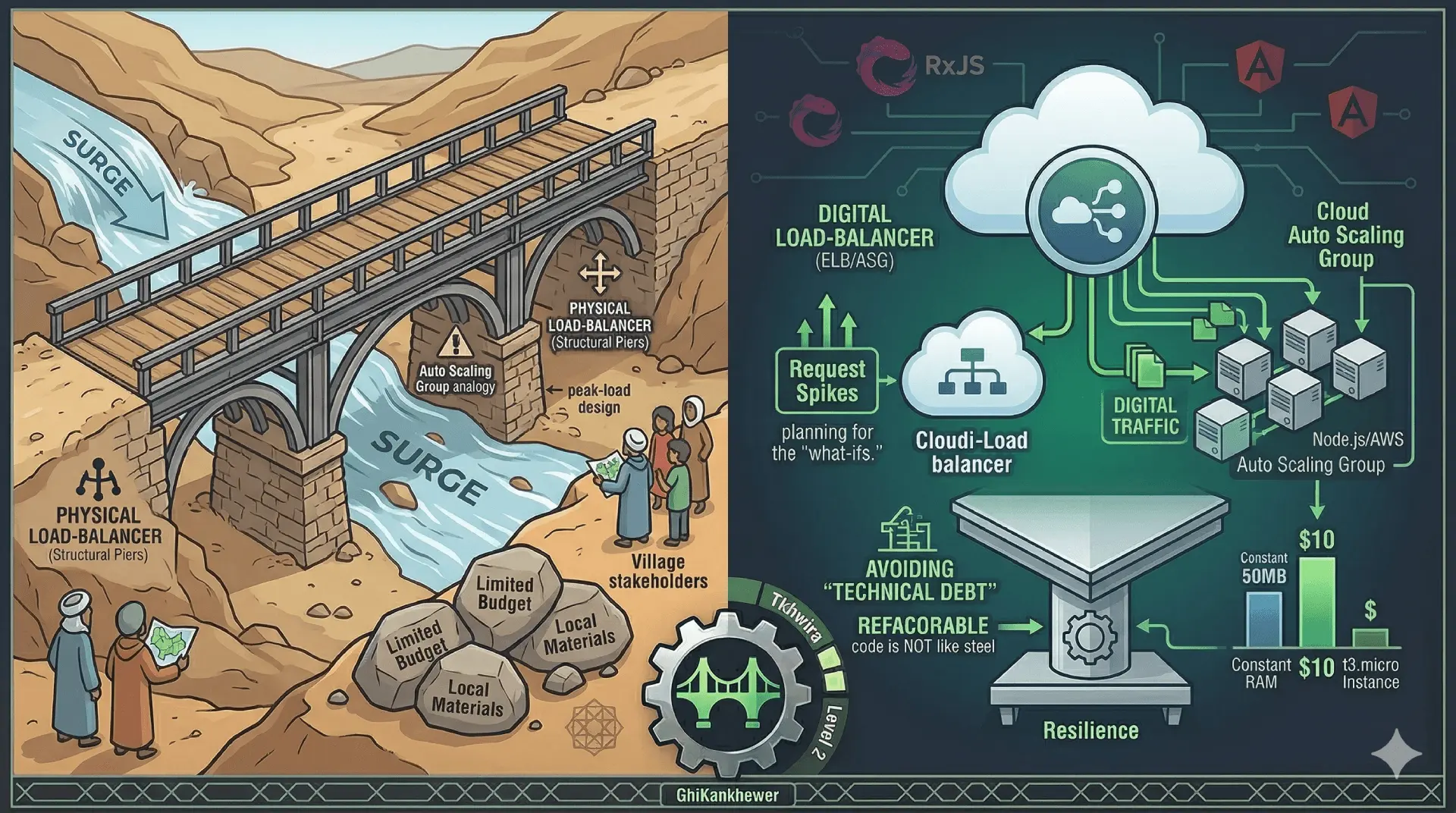
In the cloud, we worry about request spikes and CPU throttles. In the Douar, the "traffic" is a river that turns into a torrent during the rainy season. Designing the bridge’s structural support felt remarkably like setting up an Auto Scaling Group.
You aren't building for the average day; you’re building for the 99th percentile peak. If the bridge can’t handle the "surge," the whole system goes down. No rollback possible.
2. The Tech Lead’s True Job: Stakeholder Management
As a Tech Lead, your job is translating complex technical "why" into business "value." In the village, my stakeholders weren't Project Managers—they were my neighbors.
- The Constraint: Limited budget and local materials.
- The Architecture: We couldn't build a "Golden Gate." We needed a functional, safe, and cost-effective Tkhwira that could withstand a river’s version of a DDoS attack.
3. Avoiding "Technical Debt" in Steel
In software, we can refactor. In civil engineering, technical debt is literal and dangerous. If we cut corners on the foundations now, we pay for it in five years when the river claims the bridge again.
This project reminded me that whether I’m optimizing a Lambda function or calculating the arch of a steel beam, the goal is Resilience. We don't build for the sake of the technology; we build to keep the traffic—digital or physical—moving safely.
The Lesson: A good architect knows that the best "System" is the one that respects its environment and survives the storm.